MEA spokesperson Randhir Jaiswal said India's energy decisions are guided by national interest.

United States Secretary of State Marco Rubio on Thursday (local time) hailed India as 'one of the top relationships that the US has in the world today' during the Senate confirmation hearing for Sergio Gor, US President Donald Trump's nominee for US Ambassador to India.

According to the report, the Pentagon is deploying the USS Tripoli ARG, along with the 31st Marine Expeditionary Unit (MEU), part of its own strike group.
US lawmakers have expressed concerns that policies enacted by the Trump administration, such as the H1B visa fee and tariffs on India, are detrimental to American businesses and threaten the relationship between the United States and India.
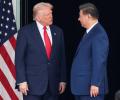
United States President Donald Trump said that China 'knows the consequences' if it attacks Taiwan, asserting that Chinese President Xi Jinping understands the situation 'very well'.
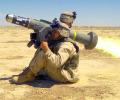
The US has approved the sale of Excalibur Projectiles, Javelin Missile System and related equipment totalling over 90 million dollars to India.
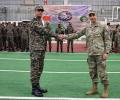
'When our soldiers trained side by side, we demonstrated to the world that our partnership is strong, enduring and prepared to meet any challenge.'
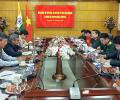
The 15th India-Vietnam Defence Dialogue signalled a move from routine talks to deeper cooperation, with new deals on submarine rescue and defence industry to support stability in the Indo-Pacific, notes Dr Rajaram Panda.

US President Donald Trump greeted India on its 77th Republic Day, highlighting the historic bond between the two democracies amid ongoing trade tensions.
External Affairs Minister S Jaishankar and US Secretary of State Marco Rubio discussed cooperation in trade, critical minerals, nuclear energy, and defence, reaffirming commitment to a free and open Indo-Pacific.

The prime minister also underlined the importance of a free and open Indo-Pacific for the Pacific island nations and said India respects the sovereignty and integrity of all countries.
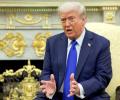
The US Representative criticised the administration's new USD 100,000 fee on H-1B visas, observing that Indians hold 70 per cent of these visas and saying the change directly harms workers who have long supported US innovation across technology, science and medicine.

The United States has warned China against escalating tensions as Taiwan detected multiple Chinese naval vessels, official ships and balloons operating around the island amid Beijing's large-scale live-fire military drills.

'Today, as I look at our satellite -- tested, finished and ready to ship -- represents 1,642 days of grit and belief.'
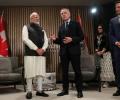
The statement suggests that Canadian authorities do not see ongoing foreign interference or violent activity tied to India at present.
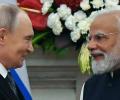
United States representative Sydney Kamlager-Dove while talking about the famous car selfie of Prime Minister Narendra Modi with Russian President Vladimir Putin said that it spoke a thousand words.
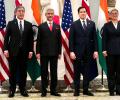
Soon after he was sworn in by Vice President J D Vance, US Secretary of State Marco Rubio hosted External Affairs Minister S Jaishankar, Penny Wong from Australia and Japan's Iwaya Takeshi for his first multilateral meeting as the top American diplomat.
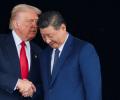
Speaking to reporters aboard Air Force One, Trump stated, "We have a deal," referring to the trade pact which will be routinely extended. "Every year we'll renegotiate the deal, but I think the deal will go on for a long time, long beyond the year. We'll negotiate at the end of the year," he added.
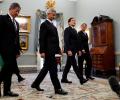
In a move sending a strong signal to China, foreign ministers from Quad countries -- India, Australia, Japan and the United States -- in a joint statement on Tuesday strongly opposed any unilateral actions that seek to change the status quo by force or coercion.
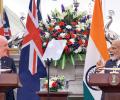
India and New Zealand have signed a pact to institutionalize their defence ties and vowed to boost cooperation in the Indo-Pacific. Prime Minister Narendra Modi raised concerns about anti-India activities by some illegal elements in New Zealand with his Kiwi counterpart Christopher Luxon. The two sides also signed six agreements to enhance cooperation in areas including education, sports, agriculture, and climate change. They also agreed to prepare a roadmap for cooperation in the defence industry sector and explore early implementation of cooperation in the digital payments sector.
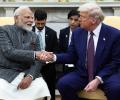
No one should make China an issue in their bilateral relations and their cooperation should not harm the interests of another country, the Chinese Foreign Ministry said on Friday reacting to queries on the meeting between Prime Minister Narendra Modi and United States President Trump.
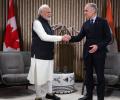
For Canada, important steps towards containing domestic elements that fuel pro-Khalistan sentiments can go a long way in signalling trust positively with regard to security and sovereignty, point out Harsh V Pant and Vivek Mishra.
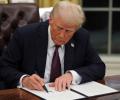
Dr Jaishankar is expected to discuss the dates for the fifth Quad leaders' summit in India later this year.
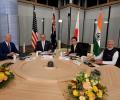
The announcement for the QUAD Caucus came from Congressman Ami Bera, Ranking Member of the House Foreign Affairs Indo-Pacific Subcommittee, Congressman Rob Wittman, and Senators Tammy Duckworth and Pete Ricketts, both members of the Senate Foreign Relations Committee.
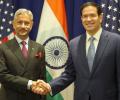
Rubio voiced "appreciation" for New Delhi's continued engagement on bilateral issues, including trade, defence and energy.

European Commission President Ursula von der Leyen says India and the EU are close to a 'historic trade agreement' that could create a market of two billion people and account for almost a quarter of the global GDP.
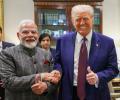
Trump announced that India and the US agreed to a trade deal under which Washington will charge a reduced reciprocal tariff on Delhi, lowering it from 25 per cent to 18 per cent.

United States Navy Chief Admiral Lisa Franchetti unveiled the 2024 Navigation Plan, outlining navy's readiness for a potential war with China over the next two years, Taiwan News.

India has joined the US-led 'Pax Silica' alliance, aimed at building a resilient supply chain for critical minerals and artificial intelligence, marking a significant step in strengthening bilateral ties and fostering economic security.
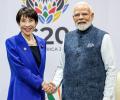
If they act now, they can reshape the strategic map of Asia without firing a shot. If they wait, the next opportunity will come only after a serious Taiwan Strait incident -- by which time the price will be far higher, and the room for boldness far smaller -- the opportunity may well be lost by then. The question is no longer whether this can or should be done, points out Varun Arya.

Meeks, a ranking member of the House Foreign Affairs Committee Democrats, on Wednesday (local time) underscored "Congress' support for the US-India partnership," following his meeting with Indian Ambassador to the US Vinay Mohan Kwatra.
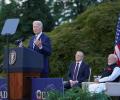
United States President Joe Biden was caught on a hot mic telling leaders of the Quad nations that China was testing them, thus reflecting upon the American seriousness of the emerging Chinese threat.
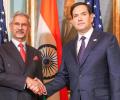
This will be the first face-to-face meeting between Rubio and Jaishankar following President Donald Trump's imposition of an additional 25 per cent tariff on India for Delhi's purchases of Russian oil, taking the total levies imposed on India by the Trump White House to 50 per cent.
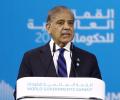
Sharif said that the US president had shown beyond any doubt that "he is a man for peace... and beneficial business deals".
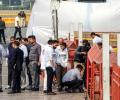
US Secretary of State Marco Rubio praises India's measured and professional investigation into the Red Fort car explosion, calling it a terrorist attack. The US has offered assistance, but acknowledges India's capabilities in handling the investigation.
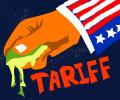
A trade deal makes sense only if it is fair and reciprocal. If the cost is strategic dependence or loss of policy space, waiting is the wiser option, asserts Ajay Srivastava.

US lawmakers have urged President Donald Trump to reconsider his proclamation on H1-B visas, including the USD 100,000 fee, asserting that Indian nationals are central to American leadership in IT and AI, and the restrictions will negatively impact US-India ties.
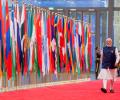
During a special briefing in Tianjin, Misri confirmed that the prime minister will first address the SCO plenary session before meeting President Putin.
Saturday's Quad meeting in Delaware is taking place against the backdrop of China's assertive behaviour in the South China Sea, its sabre-rattling in the Taiwan Strait and increasing footprints in the Pacific and Indian Ocean, asserts Rup Narayan Das.
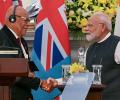
Fijian Prime Minister Sitiveni Rabuka discussed US tariffs on Indian goods with Prime Minister Narendra Modi, noting that "somebody is not very happy with you." The discussion occurred during Rabuka's visit to India to strengthen ties.
